
Croatia. And then, if you're lucky — Vis.
Croatia has been one of Europe’s most talked-about destinations for years. The coastline, the islands, the food, the history — all of it is real, and all of it is worth the attention it gets. But Croatia is also large, varied, and easy to visit in a way that leaves you feeling like you’ve seen it without quite having understood it.
This page is about why Croatia is special, what makes the Dalmatian coast different from anywhere else in the Mediterranean, and why the island of Vis — specifically — is where we chose to build something.
WHY CROATIA IS SPECIAL
Why Croatia
Croatia sits at the meeting point of Central Europe, the Mediterranean and the Balkans. It is a small country — roughly the size of West Virginia — but it contains an extraordinary range of landscapes, climates, histories and cultures within it. Mountains and coastline, Roman ruins and Cold War bunkers, vineyards producing indigenous grape varieties found nowhere else on earth, and over 1,200 islands stretching down the length of the Adriatic Sea.
It has been inhabited for millennia. The Greeks established colonies here. The Romans built palaces. The Venetians left their architecture on every coastal town. The Austro-Hungarians came after them. Each wave left something behind, and the result is a country where history is not something you visit in a museum — it’s visible in the streets, in the food, in the names of the places.
- Coastline: Over 1,800 kilometres, with more than 1,200 islands, islets and reefs
- UNESCO sites: Ten, including Diocletian’s Palace in Split and the old city of Dubrovnik
- National parks: Eight national parks and eleven nature parks covering over a third of the country
- Climate: Mediterranean on the coast — warm, dry summers, mild winters, reliable sunshine
- Food & wine: Ranked by USA Today among the world’s top five wine regions
Croatia is also, by European standards, still relatively uncrowded in the places that matter. Dubrovnik and Hvar attract significant tourist numbers in summer — there is no pretending otherwise. But the country is large enough, and the coast long enough, that the islands further out still offer something genuinely different: a version of the Mediterranean that moves at a different pace.


THE MEDITERRANEAN AS IT ONCE WAS
The Mediterranean as it once was
There is a version of the Mediterranean that most people carry in their imagination — one shaped by old photographs, by the writings of travellers from earlier centuries, by the idea of a sea that was once wild, quiet and remarkable. Clear water, fishing boats, stone villages, olive groves running down to the cliff edge. A place where you could arrive and feel that you were somewhere that had not yet been optimised for your convenience.
That version of the Mediterranean still exists. But you have to know where to look.
The Adriatic’s particular character
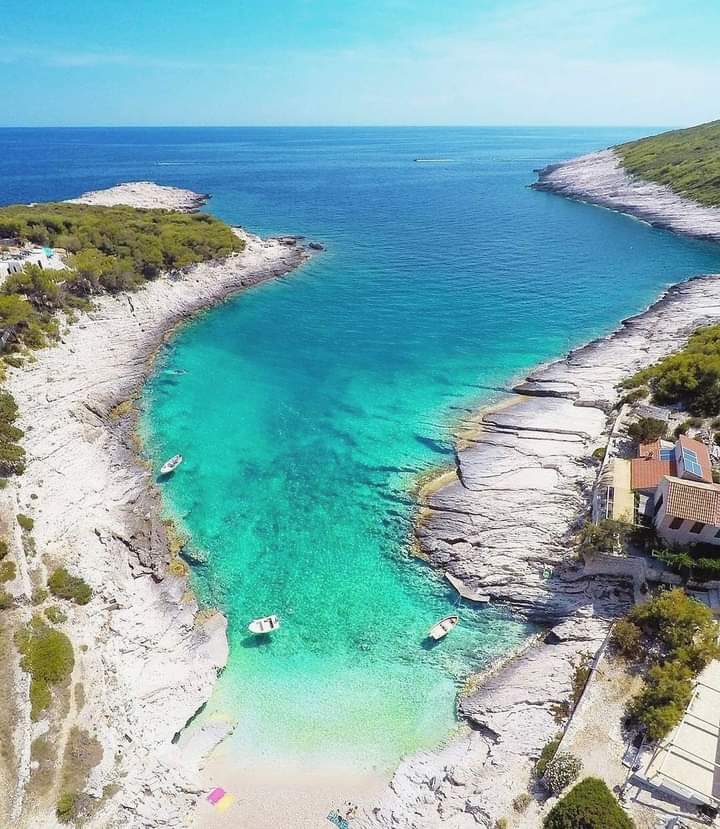
The Adriatic is the most enclosed sea in the Mediterranean — sheltered, relatively calm, and extraordinarily clear. Its water quality is among the highest in Europe: monitored, protected, and genuinely worth getting into. The combination of limestone coastline, deep blue water and long summer light gives the Croatian coast a quality of beauty that is difficult to describe accurately and very easy to recognize the first time you see it.
A coast that still has edges
The Dalmatian coast is not a resort strip. It is a living, working coastline — fishing towns, old harbours, terraced hillsides planted with vines and olive trees, paths worn by centuries of use. Behind the towns that attract tourists are dozens of smaller places that attract almost nobody: coves with no name on any signpost, villages where the same families have lived for generations, sections of coast where the limestone meets the sea and the water is cold and clear and completely empty.
The Croatian coast is what the rest of the Mediterranean looked like before the second half of the twentieth century. In places, it still does.


NATURE & ISLANDS
Over a thousand islands
Croatia has 1,244 natural formations along its coast — islands, islets, cliffs and reefs. Of these, 48 are permanently inhabited. The rest range from large forested islands with their own towns and vineyards to bare limestone rocks barely above the waterline. Taken together they form one of the most complex and beautiful coastlines in the world.
Each island has its own character. Hvar is famous for lavender fields, sunshine — it holds one of the highest sunshine records in Europe — and a lively social scene. Brač is home to Zlatni Rat, Croatia’s most photographed beach. Korčula claims Marco Polo as a native son and is covered in dense, ancient forest. Mljet is mostly national park. Lastovo is so remote it was a Yugoslav military zone until 1989.
National parks & protected nature
More than a third of Croatia’s total surface area is covered by national or nature parks. Plitvice Lakes — sixteen terraced lakes connected by waterfalls in a landscape of dense forest and limestone — is one of the most visited natural sites in Europe. The Kornati archipelago, 89 islands and reefs in a relatively small area of sea, is a national park of extraordinary geological drama. The Velebit mountains run along the coast and rise to over 1,600 metres, supporting ecosystems found nowhere else on the continent.
The Adriatic supports dolphins, sea turtles, and — in the waters around the island of Cres — one of the last remaining populations of griffon vultures in Europe. The Blue World Institute, based on the island of Vis, runs ongoing marine research and conservation programmes in the waters around the Dalmatian islands.
The sea itself
The water quality of the Croatian Adriatic is consistently rated among the highest in Europe. The combination of low pollution, strong currents, and limestone geology produces visibility that can reach 30 to 40 metres in clear conditions. For swimmers, snorkellers and divers, this matters enormously. You are not swimming in murky water. You are swimming in something transparent, cold, and exceptional.


FOOD, WINE & LIFESTYLE
Food, wine & the Dalmatian way of life
A cuisine built on proximity
Dalmatian food is simple in the right way — the kind of simplicity that requires excellent ingredients and the confidence to leave them alone. Fresh fish caught the same morning, grilled over charcoal with olive oil and sea salt. Octopus slow-cooked under a peka — a cast iron dome buried in embers — until it falls apart. Lamb from islands where the animals graze on rosemary and sage. Cheese aged in olive oil. Bread baked at home.
The cuisine reflects the history of the coast: Greek and Roman foundations, Venetian refinement, centuries of fishing and farming on islands where nothing was wasted and everything was made from what was available. The result is food that is honest, seasonal, and very good.
Wine from indigenous grapes
Croatian wine is one of the quiet surprises of the Mediterranean. Dalmatia produces wine from indigenous grape varieties — Plavac Mali, Pošip, Vugava, Grk — found nowhere else in the world. Plavac Mali, the dominant red grape of the Dalmatian islands, is the ancestor of Zinfandel: DNA research in 2002 confirmed that the grape that built the Californian wine industry originated on the Croatian coast.
The island of Vis produces Vugava, a white grape variety native to the island alone. Its wine is dry, mineral, and completely distinctive. You cannot drink it anywhere else in the world except here.
Olive oil
The ancient Romans introduced systematic olive cultivation to Dalmatia. Two thousand years later, the olive groves are still producing. Croatian olive oils — particularly from Istria and the Dalmatian islands — regularly win international awards and are considered among the finest in Europe. On the islands, olive oil is not a cooking ingredient. It is a condiment, a seasoning, a finishing touch, and in some households almost a form of currency.
The pace of life
The Dalmatian lifestyle has a name in Croatian: fjaka. It is roughly translatable as a state of pleasurable inertia — the feeling of having nowhere to be and no particular desire to go anywhere. It is not laziness. It is the conscious choice to sit, to drink something slowly, to watch the sea, to let the afternoon pass without accounting for it.
It is, in the context of modern European life, genuinely countercultural. And on the Croatian islands, it is still practised with conviction.
The Dalmatian coast runs on olive oil, Plavac Mali wine, fresh fish and the unhurried conviction that there is no good reason to be somewhere else.


WHY VIS IS DIFFERENT
Why Vis is different
All of the above — the clarity of the water, the quality of the food, the pace of life, the extraordinary natural landscape — is present on Vis. But Vis has something else that most Croatian islands no longer have: genuine remoteness, and the particular character that comes with it.
45 nautical miles from Split
Vis is the furthest inhabited island on the eastern Adriatic coast. Getting there requires a two-hour-and-twenty-minute ferry journey or a fast catamaran. That distance is not a disadvantage. It is a filter. The day-trippers who crowd Hvar and Brač in July do not make it to Vis in significant numbers. The cruise ships do not stop here. The island has no large hotels, no beach clubs, no music festivals.
What it has instead is a coastline that has been largely unchanged for decades, two small towns with genuine character, vineyards producing wine from a grape found nowhere else in the world, and a history that stretches back 2,500 years to the first Greek settlers who named this place Issa.
Closed until 1989
From the 1950s until 1989, Vis was a closed Yugoslav military zone. Foreign visitors were not permitted on the island. The Yugoslav Navy used the island’s natural harbour, built submarine tunnels into the limestone cliffs, and stationed significant military infrastructure here for four decades.
The effect of that closure was accidental preservation. While the rest of the Dalmatian coast developed, modernised and opened to tourism, Vis sat untouched. The development that reshaped other islands never came. The result, visible today, is an island that still feels like itself.
UNESCO Global Geopark
In 2019, Vis was designated a UNESCO Global Geopark — a title awarded to places of outstanding geological, natural and cultural significance. The designation recognises the island’s extraordinary landscape: the limestone formations, the sea caves, the coastal geology, and the evidence of human habitation stretching back millennia.
Geopark status is not a tourist attraction. It is recognition, by the world’s most respected scientific and cultural organisation, that this place is irreplaceable and worth protecting.
Stiniva, the caves, and the water
Stiniva beach cove — enclosed by two towering limestone cliffs, accessible only by sea or by a steep footpath — was voted the most beautiful beach in Europe in 2018. The ex-military submarine caves, carved into the rock during the Cold War, are not a reconstruction or a tourist interpretation. They are the real thing, still intact, reachable by kayak. The water around the island reaches visibility levels of 30 to 40 metres on clear days. The Blue Cave on the neighbouring island of Biševo, where sunlight enters through an underwater opening and illuminates the interior in electric blue, has been drawing visitors since the nineteenth century.
Vis wine
Vugava is a white grape variety found only on Vis. The wine it produces — dry, mineral, faintly aromatic — has been made on this island for over 2,000 years. It is not available anywhere else. The island also produces Plavac Mali, the indigenous Dalmatian red, from vineyards that in some cases predate the current buildings by centuries. Drinking Vugava on the island where it grows is one of those small, specific pleasures that no itinerary can fully plan for.
The bridge to VIScovery
Everything described on this page is what the island of Vis offers. VIScovery exists to help you access the parts of it that you wouldn’t find on your own: the sea caves and the military tunnels, the footpath down to Stiniva, the spot where the cliff is the right height and the water is the right depth, the restaurant that the locals actually eat in, the olive harvest if the timing is right.
Croatia has hundreds of islands. The Adriatic has thousands of coves. But there is only one Vis, and there is only one week that takes you into it properly.
Vis is what the rest of the Mediterranean looked like before it was discovered. The difference is that Vis knows what it is — and intends to stay that way.


Ready to see it for yourself?
Four rooms. Twelve guests. One island. May through October.

We respect your privacy. Your details are used only to respond to your enquiry. Privacy Policy · Terms We create carefully hosted weeks on the island of Vis, combining outdoor activities, relaxation, and local experiences. Every enquiry is read personally, and we’re always happy to help you plan the right week for you.
Usefull Links
© 2026 VIScovery. All rights reserved.